
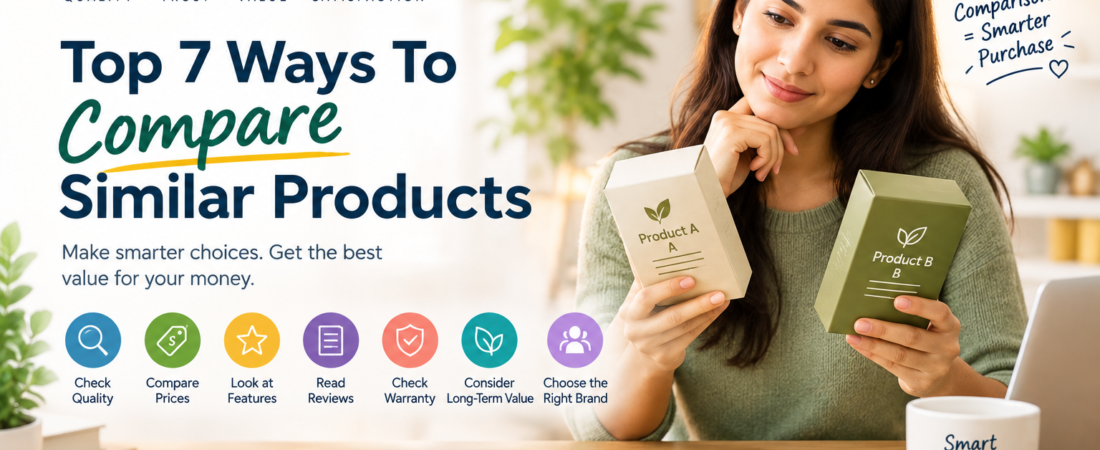
Choosing between similar products can be surprisingly difficult. When two or more products look almost identical, have similar features, and fall within the same price range, deciding which one offers better value can take some research.
Whether you are shopping for electronics, home appliances, fashion accessories, beauty products, furniture, kitchen essentials, or other everyday items, comparing products before buying can help you make a more informed decision.you compare similar products is to look carefully at quality.
The cheapest product is not always the best option, and the product with the most features may not necessarily be the right choice for your needs. The key is to compare products using the factors that actually matter.you compare similar products is to look carefully at quality.
In this guide, we will discuss the top 7 ways to compare similar products so you can evaluate your options, identify differences, and choose a product that offers the right combination of quality, features, reliability, and value.you compare similar products is to look carefully at quality.
Why Is It Important to Compare Similar Products?
When shopping online, customers often have access to dozens or even hundreds of similar products. Product photographs and advertisements can make several options appear almost identical.you compare similar products is to look carefully at quality.
However, small differences in specifications, materials, warranty, reviews, seller reputation, and long-term costs can significantly affect the overall value of a product.you compare similar products is to look carefully at quality.
Comparing similar products can help you:
- Understand important differences
- Avoid unnecessary features
- Identify better value
- Check product quality
- Reduce the risk of a poor purchase
- Compare customer experiences
- Find products that match your requirements
- Make a more confident buying decision
A few extra minutes of research before purchasing can potentially save both money and frustration later.you compare similar products is to look carefully at quality.
Top 7 Ways To Compare Similar Products
1. Compare Features and Specifications
The first step when comparing similar products is to look beyond their appearance and compare their features and specifications.
Two products may look similar but have significant differences in their technical details or functionality.you compare similar products is to look carefully at quality.
Depending on the product category, compare factors such as:
- Size and dimensions
- Material
- Capacity
- Weight
- Performance
- Compatibility
- Power requirements
- Available functions
- Included accessories
- Technical specifications
For example, if you are comparing two kitchen appliances, one may have a larger capacity while the other may offer additional functions.you compare similar products is to look carefully at quality.
Similarly, two electronic products may look similar but have different battery capacity, storage, connectivity options, or performance specifications.
Focus on useful features
More features do not automatically mean better value.you compare similar products is to look carefully at quality.
Ask yourself which features you will actually use. Paying extra for features that you never need may increase the cost without providing meaningful benefits.
Comparison tip: Create a simple list of must-have features and compare each product against it.
2. Compare Price and Overall Value
Price is one of the easiest factors to compare, but it should not be the only one.
When comparing similar products, look at the total value you receive for the price you pay.
Consider:
- Product price
- Delivery charges
- Taxes where applicable
- Discounts
- Included accessories
- Warranty
- Maintenance requirements
- Expected lifespan
- Replacement costs
For example, imagine two similar products:
Product A: ₹1,999
Product B: ₹2,399
Product B costs ₹400 more, but it may offer better materials, additional useful features, and a longer warranty.
In that situation, simply choosing Product A because it is cheaper may not provide the best overall value.
Price vs. value
Price tells you how much you pay.
Value tells you what you receive in return.
When comparing products, focus on both.
Comparison tip: Compare the final cost and benefits rather than focusing only on the displayed discount.
3. Compare Quality and Materials
Product quality can have a significant impact on durability and user satisfaction.
When comparing similar products, examine the materials and construction used in each option.
Look for information about:
- Material type
- Build quality
- Manufacturing details
- Finishing
- Construction
- Component quality
- Durability
- Maintenance requirements
For physical products, customer photographs and detailed product descriptions can provide useful information.
For example, two bags may have similar designs but use different fabrics, stitching methods, zippers, and internal materials.
Likewise, two pieces of furniture may look similar but use different frame materials or hardware.
Why quality matters
A product that costs slightly more but uses better materials may provide better long-term value if it lasts longer and performs more consistently.
However, higher price does not automatically mean higher quality. Always compare the actual materials and construction rather than assuming that an expensive product is better.
Comparison tip: Compare what each product is made of, not just how it looks.
4. Compare Customer Reviews and Ratings
Customer reviews can provide valuable insights into how products perform after purchase.
While product descriptions tell you what a manufacturer or seller claims, customer reviews can provide information about actual experiences.
When comparing similar products, look at:
- Overall rating
- Number of reviews
- Recent reviews
- Customer-uploaded photographs
- Common complaints
- Comments about durability
- Performance feedback
- Packaging experiences
- Size or fit feedback
- Customer service experiences
Look for patterns
Don’t make your decision based on one five-star or one one-star review.
Instead, look for repeated patterns.
For example, if many customers mention that Product A is easy to use while Product B is frequently described as difficult to operate, that information may be useful when comparing the two.
Recent reviews can also be helpful because product quality, manufacturing, sellers, or versions can change over time.
Comparison tip: Read positive, neutral, and negative reviews to develop a balanced understanding of each product.
5. Compare Warranty, Returns and After-Sales Support
Warranty and return policies are often overlooked when comparing similar products.
However, they can become extremely important if something goes wrong after purchase.
Before choosing between two products, compare:
- Warranty period
- Warranty coverage
- Replacement policy
- Return period
- Refund process
- Service availability
- Customer support
- Repair options
- Conditions for claiming warranty
For expensive products, after-sales support can be particularly important.
A product with excellent specifications may become inconvenient if warranty claims are difficult or service support is limited.
Check the fine print
A warranty period alone does not tell you everything.
Read what is actually covered and whether there are exclusions or specific conditions.
Similarly, check whether the product is eligible for return or replacement and how long you have to request it.
Comparison tip: Consider customer support and warranty as part of the product’s overall value.
6. Compare Brand and Seller Reputation
The brand or seller behind a product can also influence your buying experience.
When comparing similar products from different brands or sellers, research their reputation.
Consider:
- Brand history
- Customer feedback
- Seller rating
- Customer service
- Warranty support
- Product authenticity
- Return experience
- Availability of spare parts where relevant
For marketplace purchases, pay attention to the actual seller rather than only the product brand.
Two identical products sold by different sellers may provide different experiences in terms of packaging, delivery, customer support, and returns.
Don’t rely only on brand popularity
A famous brand may have a strong reputation, but that does not mean every product from that brand will automatically be the right choice.
Similarly, a less familiar brand may offer a product that meets your requirements.
Use brand reputation as one factor in your comparison rather than the only deciding factor.
Comparison tip: Evaluate the product, brand, and seller separately.
7. Compare Long-Term Value and Suitability
The final step is to consider which product is most suitable for your specific needs over the long term.
This is where all your research comes together.
Ask yourself:
- Which product meets my requirements better?
- Which one is likely to last longer?
- Which product is easier to maintain?
- Which one has better support?
- Which features will I actually use?
- Which product fits my budget?
- Which option offers better overall value?
A product with a lower purchase price may not be the better choice if it requires frequent replacement or maintenance.
On the other hand, spending more money is not always justified if the additional features do not provide meaningful benefits.
Think about total cost of ownership
The purchase price is only one part of the cost.
Depending on the product, also consider:
- Maintenance
- Accessories
- Replacement parts
- Repairs
- Energy consumption
- Consumables
- Future upgrades
This approach can help you understand the product’s long-term value rather than simply its initial price.
Comparison tip: Choose the product that best fits your actual needs—not simply the product with the highest specifications.
Simple Product Comparison Table
When comparing similar products, create a simple table like this:
| Factor | Product A | Product B | Product C |
|---|---|---|---|
| Price | ₹ | ₹ | ₹ |
| Key Features | — | — | — |
| Material | — | — | — |
| Quality | — | — | — |
| Customer Rating | — | — | — |
| Reviews | — | — | — |
| Warranty | — | — | — |
| Return Policy | — | — | — |
| Seller Reputation | — | — | — |
| Long-Term Value | — | — | — |
This makes it easier to identify meaningful differences.
Common Mistakes When Comparing Products
Even careful shoppers can make comparison mistakes. Here are some common ones to avoid.
Comparing only prices
A cheaper product is not automatically better value.
Focusing on specifications alone
A long list of specifications does not guarantee better usability or quality.
Ignoring customer reviews
Real customer experiences can reveal problems that product descriptions don’t mention.
Choosing based only on brand name
Brand reputation is useful, but the specific product should still be evaluated.
Ignoring warranty and return policies
These policies can become important if the product doesn’t meet expectations.
Buying more features than you need
Extra features can increase the price without providing useful benefits.
Quick Checklist: How to Compare Similar Products
Before making your final decision, check:
☑ Features and specifications
☑ Price and total cost
☑ Material and build quality
☑ Customer reviews and ratings
☑ Warranty and return policy
☑ Brand and seller reputation
☑ Long-term value
☑ Suitability for your needs
If you compare these seven areas carefully, you can make a more informed purchase decision.
Conclusion
Knowing how to compare similar products can make shopping easier and more effective.
Instead of choosing a product based only on price, appearance, or advertising, take a broader approach. Compare features, price, quality, reviews, warranty, brand reputation, and long-term value.
Remember that there is no single product that is best for every customer. The right choice depends on your requirements, budget, priorities, and expected usage.
The goal of product comparison is not simply to find the cheapest or most expensive option. It is to identify the product that provides the right balance of quality, functionality, reliability, and value.
Before clicking the “Buy Now” button, take a few minutes to compare your options.
for more information contact us